Why, with all the glory of a great blue ocean up for grabs, would anyone want to mess about on some stank assed river? It’s a question I’ve asked myself a few times over the course of my rowing career. I’ve asked it of a few others as well. While I still maintain that people who only row on rivers are missing out on a good thing (surfing back into harbour, in the moment when the sea picks up and throws the whole assemblage of crew and boat – that’s one of the good things) I’ve been reluctantly forced to concede that the reverse might also be true.
I’ve probably been brought around to that position by getting into kayaking, but this past weekend has also been an interesting insight. The first race I’ve ever rowed on a river, and because there’s no sense in doing things by halves it was also the longest and the largest race I’ve ever been involved with.
Held every year since 1988 the GRR takes place on the Thames, going straight through the middle of London. This year, according to the results, 267 boats took part. The race runs for 21.6 miles, launching from the Isle of Dogs just south of Canary Wharf and finishing at Richmond. The distance isn’t as bad as it sounds – the race is run on a rising tide which helps you along by a few knots. In our category the cox, rowers and passenger (and race rules require that a passenger must be carried) can swap in and out mid-race, so that any one rower only rows two thirds of the course. All the same – it’s an undertaking.

Race format – slowest boats cross the startline first, and every boat gets both a total time which reflects the time from start to finish (backed up by an onboard transponder), as well as a handicap time based on their finish time and the class of boat. Some boats are a lot speedier than others. For me one of the greatest things about the whole undertaking was the sheer variety of classes taking part. Entry is restricted to traditional, fixed seat rowing boats (with easesments for certain classes of outrigger canoes and rafts) – this was not the territory for Olympic style racing shells. The GRR website lists thirty types of boats as classes, not including “Other”. The thirty includes seven types of Gig and six types of Skiff. In amongst it, all those evocative names – Thames Waterman Cutter, Harker’s Yard Gig, Thames Triple Skiff. Pieces of history here. One of the many reasons I’m glad there are events like this. We connect with our past, we keep old skills current. After the bomb drops we’ll need some way to get from here to there. If it worked for Lewis and Clark it can work for us.
Anyway.
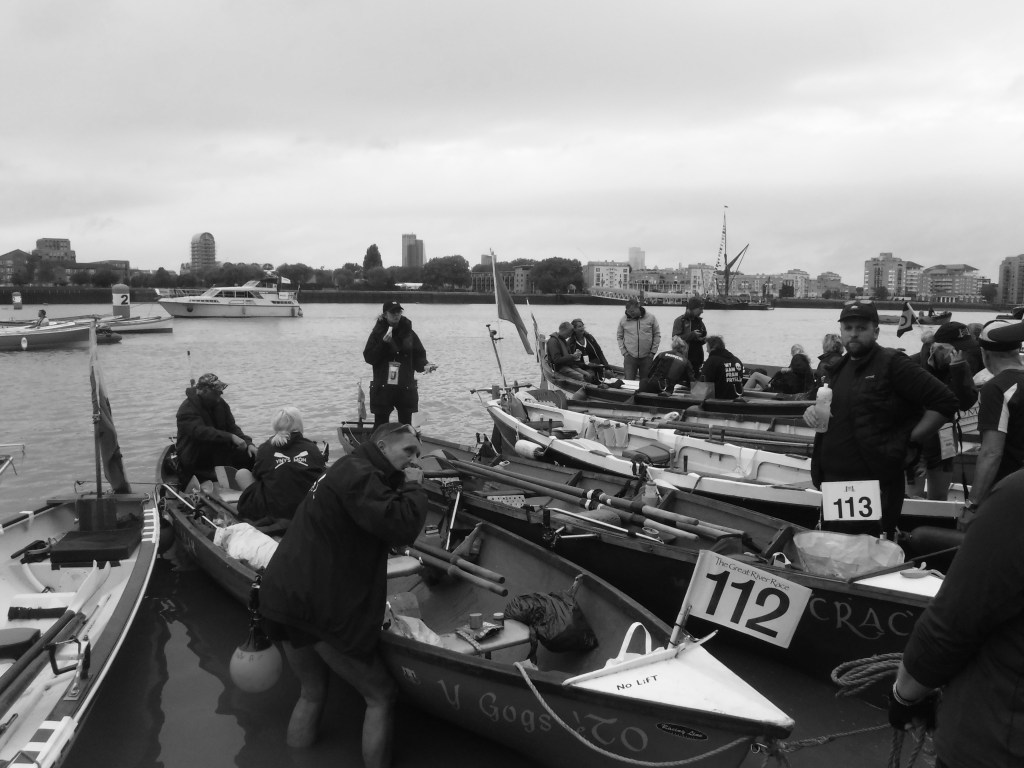
Foreshore of the Isle of Dogs. The boats have been towed down from Richmond where they went in to the water last night. I’ve met up with the crew, and we’re doing the last minutes stuff – strapping cushions onto the thwarts, mounting the rudder, locking oars into the rowlocks. The tide’s coming up quickly – every few minutes the boat starts to drift sideways a little and we have to drag her a little further up the beach. In fact the tide was coming in a little too briskly, and before too long the beach couldn’t be accessed from the slipway (even with the assistance of the organiser’s floating pontoon). This put us in an awkward position, with three of our team having gone off to queue for the toilets, and now presumably being stuck on the other side of the deepening water. Eventually we crewed up a boat and went off to find them.
A few minutes later, having shuffled everyone aboard their relevant boats, we were on the Thames. Simple enough set of words, but if rivers and history are to run united, then the Thames must be a prime example. There are other rivers with a human history, and older ones at that – the Tiber and the eternal city, the Jordan running its course through the Holy Land, perhaps the Nile most of all. But the Thames – if you’re like me, someone who’s a regular visitor to London but has never lived there, then it might conjure up mystery. Creeping fogs, Sherlock Holmes, the great stink, air raids, ports, docklands where ships from all corners of the world discharged their cargo. There’s a lot to unpack there. Not that I had the opportunity at the time as we waited to be called into the starting area, with our bow pointed downriver and rowing against the flooding tide to keep our position.
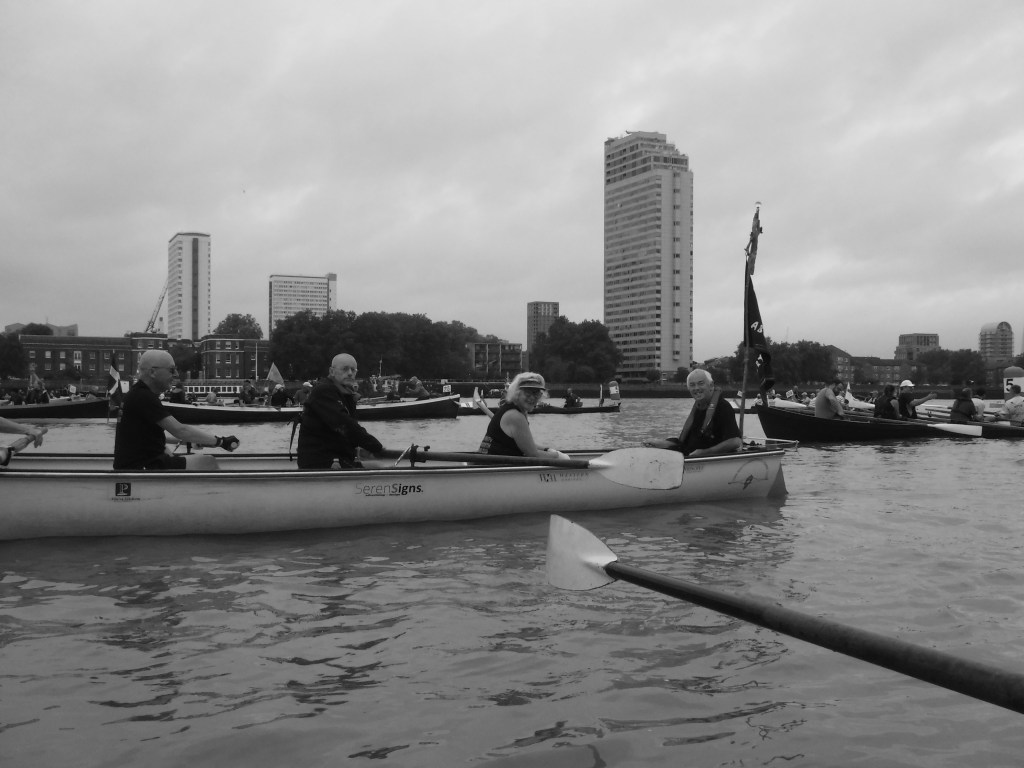
Soon enough our number came up, we rowed around into the starting area and then across the line. And off we went.
Every sort of boat to be seen. As we worked our way up river we’d keep pace with some, overtake others. Our own boat – Branwen – is a Celtic Longboat, a fibreglass one-design racing class, based on a much older design. Setting a pace we could keep up for twenty plus miles, keeping the boat shifting along in the shadow of the towers on Canary Wharf.
If there’s one thing that those hours (three hours, six minutes and five seconds according to the race timings) taught me about London it’s this – most of the recognisable stuff is very close together. For the first third of the race it seemed like every other minute we were going past something famous or eye catching – Tower Bridge, the Tower of London, the Globe theatre on portside, the dome of St Paul’s to starboard, the Palace of Westminster – and then, just after we’d gone under Chelsea Bridge and lost sight of the stacks of Battersea Power Station, suddenly that was it for the landmarks, and we weren’t even halfway done. If there’s a second thing, it’s that the Thames is a long way from any sort of natural state. The assumption with a river is that it gets wider as it reaches the sea, so rowing upriver you would expect it to narrow. Not the case – with the reaches through the city being canalised between the embankments it narrowed as we rowed through and then seemed to be widening again as we went up.
Keep ploughing on. A third of the way through we shuffled the rowers – our passenger got in to row, the cox swapped into a rowing seat and I got in to steer. The shuffling was complicated a little, because we were rowing in a mixed class – if you are under way, then you must have two men and two women rowing.
If I thought that my spell in the seat would be the easy bit, I was wrong. The Thames is a fairly large river (not Mississippi or Yangtze sized maybe, but big enough), but two hundred and sixty some boats will take up quite a bit of space. This is compounded by the bridges – we’re not the only traffic on the Thames, and so we’re restricted to which bridge arches we can navigate. This leads to choke points, and it’s compounded by coxing a faster boat – you’re having to weave back and forth, make overtakes, not ram anyone….I won’t bore you with the play by play, but suffice to say that when most of your coxing has been offshore with the entire Irish Sea to navigate in, it’s a bit full on. I managed it without turning the boat over, hitting a bridge or actually ramming anyone else (although when that wake from the ferry shifted us sideways fifteen feet, it came closer than I’d have liked…..).
Keep rowing. Past massive, high-sided craft with two men per oar rowed by crews of Dutch guys in shirts and braces, past the school entries, the Sea Scouts, past the crews in their identical Helly Hansen kit and past the folks who are dressed….well like we are. Starting to feel it now. Keep flexing your fingers on the oar to ward off cramp. Try to ignore the aches which are setting in….everywhere. Starts with your hands, then your arse, then legs, arms, and by that point it’s more or less full body.
The last third is a bit of a blur. Fewer landmarks, and we seem to be slowing (and it’s not just exhaustion speaking, the tide is helping you less as you move up river). Wave and cheer from the waterfront as we go through Richmond, and then the final burst as we move up to the line. Done.
Now the small matter of getting a few hundred boats out of the water and onto their trailers. However it was organised, it was only ever going to be carnage, and so it proved. Then there was beer, and most welcome it was. Before I did much else I stepped over the side of the boat and stood knee deep in cold water for a couple of minutes while it drained some of the heat and ache out of my limbs.
That’s my first river race. I thought that was going to be me for the season, but it wasn’t – that’s another story. If I have one takeaway from the thing it is that the sport is both larger than you might think, but also a small community – this was brought home when I found myself in the line for beer refills next to a rower from one of our local rivals. Other than that…the Thames seems to be in decent shape. That’s a non-scientific analysis from a man with other things on his mind, but all the same – the boat didn’t end up coated in floating scum, and the river didn’t stink in the way I’ve come across in other places. Maybe I saw it on a good day. Who knows. Water quality is a vexed issue at the moment, and one I’ve no time for here.
Lastly….I may have to take back some of the things I’ve said about river rowing. Some. Not all.

 Photos By Alex