In the last post, I said I was going to speak to you about a journey. But in that post I had to say what the purpose of the journey was. A journey without purpose is hardly a journey – it’s a jaunt at best, or a holiday, or a case of “to travel rather than to arrive”.
I’ve told you what it was about. Airplanes. Big ones, small ones, the legendary and the unknown, the centrepieces of national museums and the pride of a small clutch of volunteers. Well, that was the journey. Starting in Aberystwyth to proceed via Birmingham and Newport to Bristol, there to investigate the Bristol Aerospace Museum (based at the old Filton Airfield). Then, after a night in Bristol, to head to Swindon, then to depart Swindon bright and early for Kemble, where at the Costwolds Airport an outfit by the name of The Buccaneer Aviation Group would be putting one of their tame Blackburn Buccaneers through its paces.
And all of that was awesome, and I’ll write about it at length, but right now we’re discussing the journeys, not the destinations.
I should explain at the outset, that I’m not driving to these places – anyone in the UK will have examined my route from mid-Wales to Bristol and figured that out already. While there are times that I find myself wistfully examining the cost of second hand vans, you can buy a lot of film for that sort of money, and when you buy film you’re not waiting for the exhaust to fall off or the wheel arches to rot. So it’s a combination of trains, busses and shanks pony. Many fine journeys have been undertaken with these tools.
So. Get up off the station bench. Pick up the rucksack. Two cameras, four sets of lenses. Cables, batteries, cards, film, light meter. Toothbrush. Clean pair of socks if there’s room. Then the tripod bag, that black nylon rifle case that goes over you shoulder, and will require one hand to keep it there, so you’ll spend the trip as a one-armed bandit.
Discover that you are now too large to fit comfortably down the aisle of a train.
I’m not the first person to discover this. It’s ironic that the author whose work sums it up for me was travelling for similar reasons. When serving in the RAF (under an assumed name – look into it, it’s a fascinating story) T E Lawrence, known to history as Lawrence of Arabia, made the train journey from the recruit depot to his posting. Writing in his book The Mint he described it brilliantly. Encumbered with uniform, hobnailed boots, overcoat, pack, bayonet (and he questioned the need for that on the Great Northern Railway), ration bag, water bottle, kit bag (“only eighty more pounds”), he set off, to discover that:
“The trip slowly convinced me that this military equipment was not designed for peace-time trains. I had become too wide to advance frontally through any carriage door. In each queue or press I jabbed the next man with a buckle in the mouth, or browned the next woman with my equipment’s clay. When I sat, the little side-bags and skirts of my clobber occupied two places.”
The longer I travelled the more kinship I felt with that man a century ago (Lawrence joined the RAF in 1922), and I imagine I greeted the Travelodge with the same relief he greeted the arrivals hut.
But once off the train at Patchway (a minute suburban station on the northern fringe of Bristol) I could begin the real part of my journey – the part conducted on foot. You can’t appreciate a distance until you’ve walked it, and you see the interesting places that way. The walk from Patchway station to the Aerospace museum isn’t too long and it’s not too arduous. It’s in good pedestrian country, where the pavements are wide and the traffic lights take account of the non-motorist. But there’s a bit of an odd interface between the industrial areas, the old airfield, and the new housing that’s going up. Something a little Ballardian.
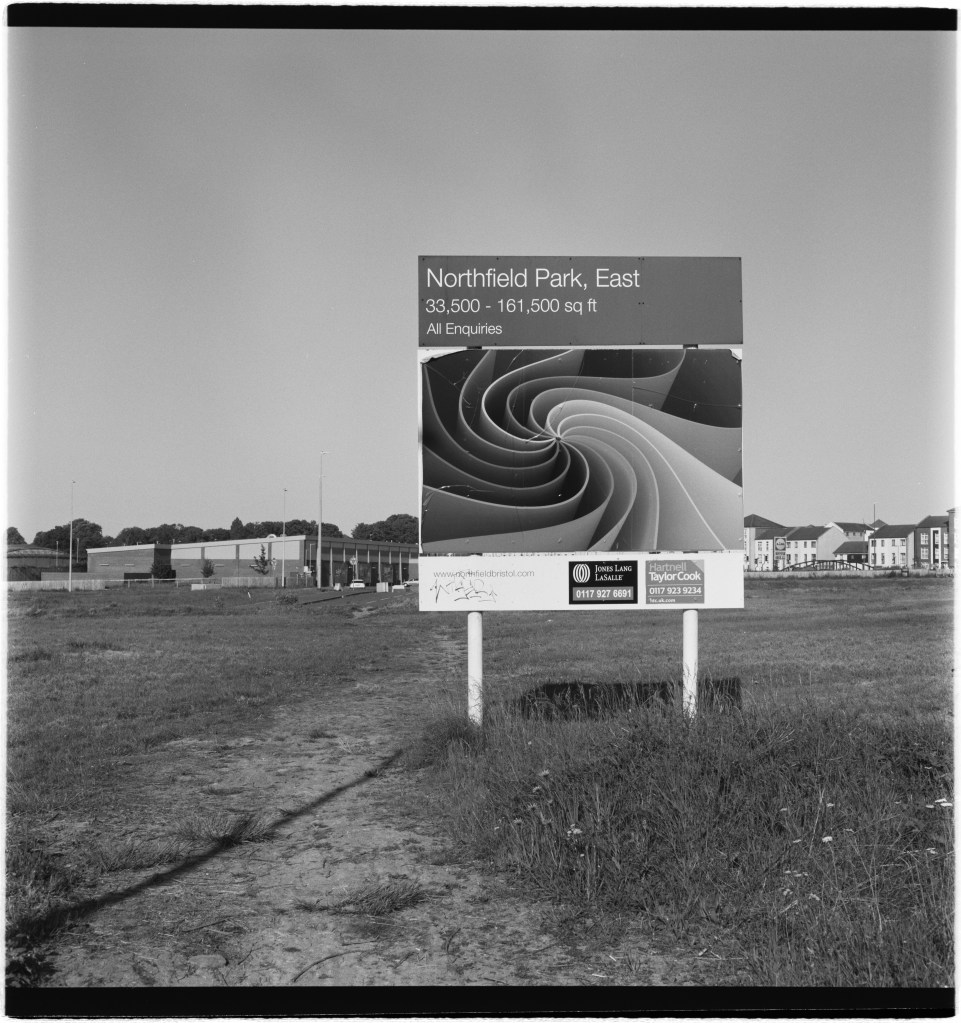
It’s a great word, Ballardian. It refers to J G Ballard, the author, and specifically to the urban landscapes that he depicted in his writing. Most notably, he depicted it in his three novels Crash, Concrete Island and High Rise. He wrote them in sequence in 1973, 74 and 75, and they all deal with the impact of the modern urban landscape on their characters. In the gap between the industrial, the derelict and the new, I found a little island that put me in mind of that work.

I took the camera out the next morning before breakfast, and finished up a roll of film with a few images. See what you think. They’re not beautiful. But there’s some sense of mystery there. I had a similar experience some years ago, when after climbing out of a broken-down car in which I’d been a passenger, I walked a few yards down the pavement on the side of an expressway outside Boston MA. And I suddenly wondered, how long had it been since anyone had stood here? Did people walk here? There was nothing within ten miles that you could access on foot. Did this spot mean anything to anyone? Did it have a story? A history? A feel, as William Gibson put it of “watching mythss take root in a parking lot” (it’s in Mona Lisa Overdrive, book three of the Neuromancer trilogy – if you haven’t read them, drop everything until you have).
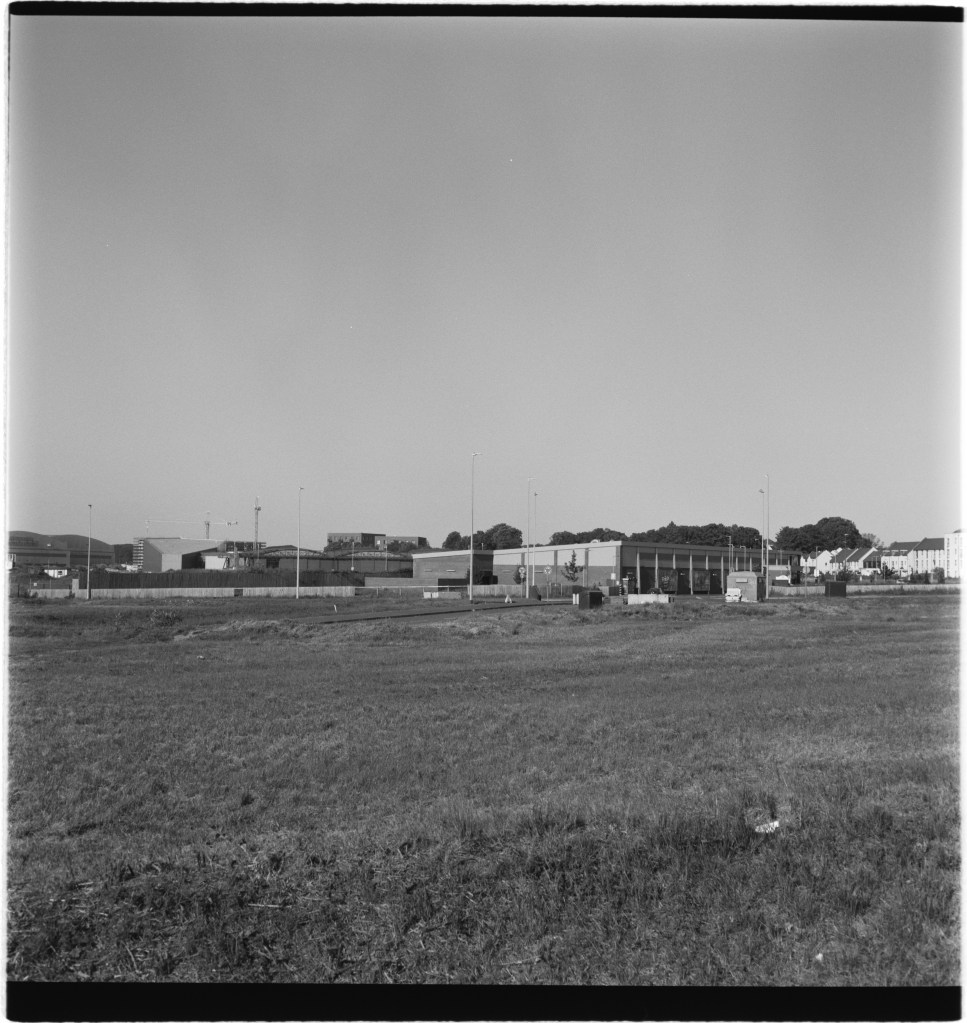
From an artistic point of view, I’m far from the first to wonder about things like this, and the link between people and their built environment. It’s given rise to its own branch of study, psychogeography which studies just that (I was introduced to the term by one of my students back when I was lecturing – another classic example of me learning more than I ever taught!). But these few orphaned roads caught my interest. I’m assuming that the orphaned road once gave access to the old Filton Airfield, prior to its closure back in 2012. If I’d driven to the museum I might not have noticed. Even if I had, I doubt I’d have been able to easily stop and look. Maybe on a quiet road out in the back country (and there’s plenty of those in my neck of the woods) but on a suburban trunk road? Not a chance.
The point is that to really find the unexpected, you need to travel slowly, and on foot if you can (that’s probably not a strict requirement – you could most likely manage the same thing on a bike, possibly even a small motorbike – but then I’d have had to get one of those to where I was). Move slower, shoot slower. Don’t always travel via the obvious paths. Take circuitous routes.
All of which leads me to an interesting conclusion. Whatever I photograph, I seem to default to being a street photographer. In the near-decade since I was pounding pavements on Manhattan Island and figuring out what photography meant to me, I’ve learned quite a bit, both technical and artistic, but in essence I’m still drawn to the thrill of the new, the unseen, the undiscovered.
And in this project – the unseen will lurk in darkened museums, on old air-bases, behind the frames of famous brethren.
Perhaps next time, I’ll tell you about it.
Psychogeography: a beginner’s guide. Unfold a street map of London, place a glass rim down anywhere on the map, and draw round its edge. Pick up the map, go out into the city, and walk the circle, keeping as close as you can to the curve. Record the experience as you go, in whatever medium you favour: film, photograph, manuscript, tape. Catch the textual run-off of the streets; the graffiti, the branded litter, the snatches of conversation. Cut for sign. Log the data-stream. Be alert to the happenstances of metaphors, watch for visual rhymes, coincidences, analogies, family resemblances, the changing moods of the street. Complete the circle, and the record ends. Walking makes for content; footage for footage.
Robert MacFarlane, A Road of One’s Own. (as quoted in the introduction to Merlin Coverly’s Psychogeography – Pocket Essentials, 2006).

 Photos By Alex